

ShoEi Foods Group Basic Policy on Sustainability
1.Basic Policy
Based on our management philosophy of "contributing to society by creating a new food culture through the provision of safe and secure foods carefully selected from Japan and overseas," the ShoEi Foods Group will help to realize a sound and bright society by proposing and providing foods, creating health through the provision of nourishment, and creating smiles and happiness through the provision of nice tastes.
In the course of doing business, we must consider not only our own profits but also our environmental impact, and reduce this as much as possible. We believe that we must make our society a better place through our business operations, by contributing to the achievement of the SDGs' goals and the resolution of social issues that our stakeholders require.
In pursuit of our management philosophy and the realization of a sustainable society, our group is aiming to be a company that is trusted and needed by society, where individual employees think for themselves, have a sense of ethics, and act in compliance with laws and social norms.
2.Environmental measures
-
Compliance with environmental laws and regulations : We comply with laws, regulations and self-regulations relevant to the countries and regions in which we operate, and aim to comply with international standards and norms.
-
Provision of safe and secure products : We strive to provide safe and secure products that are friendly to the global environment.
-
Reduction of environmental pollutants :We strive to prevent pollution by properly managing environmentally hazardous chemicals and other environmental pollutants.
-
Reduction of environmental impact : We strive to improve the efficiency of our use of energy, raw materials, and water throughout our business operations and to reduce greenhouse gases (CO2, CFCs, etc.), thereby reducing our environmental impact and curbing global warming.
-
Resource conservation and waste reduction : We will strive to implement carbon management, including the promotion of energy conservation and the visualization of energy use, and to reduce waste.
-
Protection of biodiversity :We strive to deepen our understanding of biodiversity, maintain and conserve biodiversity, and protect ecosystems.
-
Raising environmental awareness : We will raise the environmental awareness of all group employees through awareness programs and environmental education, including on nature and living things.
-
Contribution to local environmental improvement : We contribute to the creation of better local environments through communication with neighbors and local communities.
-
Requests to the Supply Chain: We seek understanding from all businesses forming the value chain, in our Group's business activities including suppliers, understand and implement measures addressing climate change such as CO₂ emissions reduction, energy conservation, water usage reduction, reduction of environmental pollutants, waste reduction, biodiversity conservation, efficient resource utilization, and consideration of other environmental issues.
3.Social measures
- For customers:
- We will work to prevent accidents by proposing and providing safe and secure foods and establishing an advisory service.
- Along with the pursuit of tastiness, we will work to contribute to achieving a healthy and long-lived society.
- By supplying products that meet customer needs at our plants in Japan and overseas, we aim to contribute to resolving such issues as reforming the way our customers work and reducing labor shortages and food waste.
- We will consider diversification of raw material supply areas at any time and strive for stable supply.
- For suppliers:
- We will conduct fair and proper trading and build and maintain relationships that enable us to prosper together.
- We will work together on key CSR issues (human rights, labor practices, and environmental impact).
- For shareholders:
- We strive to increase management transparency and to disclose company information in a fair, timely, and appropriate manner.
- Based on our mid- to long-term vision, we will strive for sustainable growth and increased corporate value.
- We will work to strengthen our governance and establish constructive dialogue.
- For employees:
- We will strive to respect human rights, eradicate harassment and discrimination, and increase education and awareness of occupational health and safety.
- Based on the idea that employee health is the key to a sustainable company, we will promote work-life balance and mental and physical health management, striving to create a happy and comfortable working environment where every employee can fulfill their potential.
- We will try to nurture our employees’ abilities, creating a workplace that offers career development and job satisfaction through skills development training and other programs.
- We will strive to improve working conditions such as salaries and benefits as fair compensation for work.
- We respect our employees' freedom of association and the right to collective bargaining, and will communicate appropriately to resolve issues related to workplace and employment conditions.
- For local communities:
- We consider our impact on the environment and are committed to reducing our environmental footprint.
- We will strive to coexist in mutual prosperity as a member of our local and international communities, and to contribute to the safe and sustainable development of local communities through our individual thoughts and actions.
- We will also promote dialogue with local communities and participation and collaboration in local events.
- For NGOs and NPOs:
- We appreciate the significance of social activities that are not intended for profit, and will actively discuss and participate in such activities.
- We appreciate the significance of social activities that are not intended for profit, and will actively discuss and participate in such activities.
ShoEi Group Code of Conduct
This Code of Conduct is aimed at all officers and employees of ShoEi Foods Corporation and Group companies, and sets forth standards and guidelines for behavior that will ensure awareness of compliance and fulfilment of social responsibility, enabling everyone in the Group to devote themselves to their duties with pride. We hope that all officers and employees remain fully aware that a business cannot exist without the trust of society, and that they work diligently in accordance with this Code, based on a full understanding of its aims.
1. Respect for the founding spirit and founding principles
As the characters in our company name imply, the founding spirit of our group is "to prosper correctly," which can be said to be the starting point of compliance. Furthermore, the founder took on challenges with a positive attitude, believed in infinite possibilities, and dreamed of doing business with the world, and worked towards making that dream a reality. We will again reflect on the founding aspirations and principles of our predecessors and, with the mutual understanding, trust and cooperation of our business partners, we will inherit the importance of business aimed at prosperity, the spirit of gratitude and service, and we will open up a new path that will not be a disgrace to the world.
2. Legal compliance and social responsibility awareness
(1)We always uphold law and order with high ethical standards and act in a civil and responsible manner.
(2)We deal strictly with any illegal or antisocial behavior.
(3)We have a proper understanding of the content of applicable laws and regulations in our business operations and act responsibly in compliance with licensing procedures etc. and in line with social norms.
3. Provision of safe products
(1)We always give top priority to the safety of our customers and conduct quality control with great care and sensitivity from a company-wide perspective.
(2)We completely eliminate illegal and defective products and provide only trusted products to the market.
(3)We provide customers with correct information about products and other items to ensure satisfaction and peace of mind.
4. Social contribution and environmental protection
(1)Every officer and employee thinks and acts on their own initiative in order to make a positive contribution to society by always trying to coexist in mutual prosperity with local and international communities.
(2)We aim as a company to contribute to the harmony and coexistence of sound global environmental protection and social prosperity, by considering and reducing the environmental impact of our business operations and working to protect biodiversity.
5. Prohibition of unfair trading
(1)We do not engage in unfair or illegal trading that violates the principles of public policy or market competition.
(2)We do not engage in price-fixing, collusion, or other unfair relationships with counterparts with regard to conditions such as transaction prices and services.
6. Maintaining healthy relationships with stakeholders, trade partners, and trade partner executives, and preventing corruption
(1)We maintain healthy relationships in our business development with stakeholders, trade partners, and executives of trade partners, free from criticism by society.
(2)We strive to prevent corruption by, for example, not offering or accepting money, gifts, hospitality, or any other benefits that exceed socially accepted norms.
7. Organized crime measures
(1)We do not associate in any way, and for any reason, with organized criminals or other groups that affect the order and safety of society.
(2)We do not engage in, overlook, or have any vested interest in behavior that could encourage the activities of such groups.
8. Respect for human rights, prohibition of harassment, discrimination, and forced labor
(1)We are conscious of being a member of the international community and local communities, and act with a proper understanding of and respect for the laws, cultures and customs of the countries and regions concerned.
(2)We are committed to securing a positive, safe and comfortable working environment by respecting human rights, without any discrimination based on race, gender, age, nationality, religion, mental or physical disability or status, and by eliminating sexual harassment, power harassment, acts of violence, forced labor, child labor or any other infringements of human rights.
(3)We play our role in creating a prosperous and comfortable society while respecting the personality and values of individuals, respecting their privacy and not infringing upon it unjustly, and always keeping in mind harmony with all parties concerned.
9. Company’s interests, and distinction between business and personal matters
(1)We always act in the interests of the company and never act contrary to the interests of the company.
(2)We distinguish clearly between the company's position and the individual's position, and do not bring personal interests into the company or use the company's position or assets for personal use. In addition, we do not engage in profit-making activities for personal use.
10. Appropriate accounting reporting and processing
(1)The company’s assets are not used for any illegal purposes.
(2)Accounting processing and reporting must be in accordance with the actual situation, in line with internal rules, and based on proper standards generally accepted as fair and reasonable.
(3)There is no false processing that differs from the actual situation, or inappropriate processing that could be misleading, such as deliberately changing the time when processing was carried out.
11. Appropriate management and prevention of infringement of intellectual property rights
We respect the intellectual property of other companies and strive to create such a corporate culture, both in Japan and overseas.
12. Appropriate management and disclosure of information
(1)We continue to maintain a corporate structure that is reliable and trustworthy by appropriately managing and protecting the information obtained in the course of our business.
(2)We strive to prevent insider trading by disclosing corporate management information in a timely and appropriate manner.
(3)We do not spread rumors, etc.
13. Implementation of supply chain CSR procurement management
We do not base our purchases solely on product quality, price and supply capability but, wherever possible, take into account CSR aspects in the supply chain (e.g. human rights abuses, forced labor, child labor, legal wage payments, working hours, work environment, and the environmental impact of production sites and processing plants).We seek understanding from all businesses forming the value chain, related to our Group's business activities including suppliers, regarding our human rights initiatives. These initiatives, outlined in our Sustainability Basic Policy and the ShoEi Group Code of Conduct, include prohibitions on child labor and forced labor, prohibitions on discrimination, and respect for freedom of association and the right to collective bargaining. We promote respect for human rights.
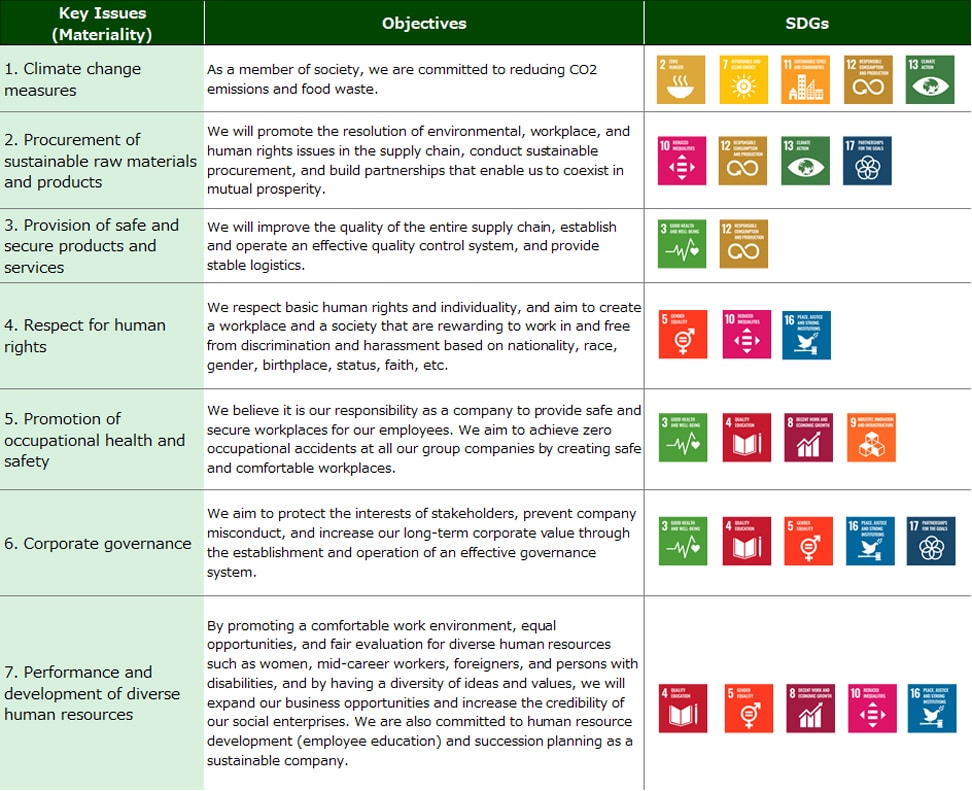
ShoEi Foods Group Materiality
We have established the following materiality issues that our stakeholders expect of us and that we must address in order to achieve sustainable growth.
Disclosure under the TCFD Framework
The ShoEi Foods Corporation group (The ShoEi Group) recognizes that climate change is an important issue that affects the sustainable growth of our business. We assess risks and opportunities that climate change poses to our business, and disclose governance, strategy, risk management, indicators and targets.
|
Governance |
|
The ShoEi Group, which mainly handles processed agricultural products and processed dairy products, is exposed to droughts, floods, storms, and other abnormal weather and global warming caused by climate change, which will damage raw material production areas and create major risks in raw material procurement. In order to avoid this risk, the ShoEi Group has established a Sustainability Committee chaired by the President and CEO as a subordinate body of the Board of Directors to discuss risks and opportunities in climate change and consider countermeasures. In addition, an independent outside director participates in this committee as a member in order to receive an objective and rational evaluation from the outside. The results of the discussion in committees are reported to the Board of Directors at least twice a year. The Board of Directors makes decisions based on a comprehensive perspective, taking into account the impacts of climate change and the results of environmental assessments. |
|
Strategy |
|
|
The ShoEi Group imports and procures processed raw materials and commodities of agricultural and dairy products from around the world. Therefore, climate change is expected to have a wide range of effects, including drought and sunshine, massive outbreaks of pests, inactivity of insect vectors using honeybees and other insects essential for pollination work, supply instability due to bad harvests, poor quality, price hikes, changes in consumer preferences, and changes in suitable agricultural production areas. The entire group closely monitors these changes and considers diversification of suppliers, diversification of risk, market analysis of transition risk, and investigation of trends in emerging production areas, in order to ensure a stable supply of products to customers and to propose alternative products. |
|
Risk management |
|
The ShoEi Group promotes risk management by establishing a Risk Management Committee, a Sustainability Committee, etc., in order to appropriately respond to risks that have a serious impact on the company. Among them, "climate change" is also positioned as an important management risk, and the Sustainability Committee comprehensively evaluates the risk level and impact of physical risks, legal regulations, market transition risks, etc., and measures to respond to them. The results will be reported to the Board of Directors, which will supervise and appropriately reflect them in management to promote risk management. |
|
Indicators and Targets |
|||||||||||||||||||||
|
1.Reduction of CO₂ emissions Our group measures CO₂emissions at all domestic and overseas locations (including branch offices and manufacturing plants), and has set a target to reduce the CO₂ emissions (the sum of Scope 1 and 2) by 30% by 2030 compared to the base year of 2022. (Note that while the reporting period was previously set as the one-year period ending in March, we have now aligned it with the reporting period used in our financial statements.)
Compared to the base year, emissions have been reduced by 8.5% for Scope 1, 6.0% for Scope 2, and 7.2% for Scope 1 and Scope 2 combined. Our Group will continue to advance initiatives to reduce CO2 emissions from a medium- to long-term perspective at our domestic and overseas locations. ※1. Scope 1 refers to greenhouse gas emissions resulting from our own fuel consumption and direct emissions from industrial processes.
|
|||||||||||||||||||||
Overview of Scenario Analysis based on TCFD Recommendations
In identifying medium- and long-term business risks and opportunities due to climate change, we analyzed and summarized the impact of greenhouse gas emission control and procurement and production of main commodities (agricultural and dairy products) under two scenarios: the 4°C scenario, in which the global average temperature rises 4°C, as announced by the IPCC (Intergovernmental Panel on Climate Change), IEA (International Energy Agency), and the 2°C scenario, in which the global average temperature is kept below 2°C as agreed in the Paris Agreement.
①Scenario Analysis: Risk (Common scenario 2°c and 4°c assumed)
*Worldview Of The 4°C Scenario
Regulations to limit temperature rise will be less stringent than in the 2°C scenario (Transition Risk)
Negative impacts on the environment and human activities become more pronounced with rising temperatures. (Physical Risk)
Transition Risks
|
Major Category |
Small Category |
Impact On Business |
Importance |
Response Measures |
|
Policy / Regulation |
Carbon tax, carbon credit, etc. |
|
Significient |
|
|
Strengthening GHG emission regulations |
|
Medium |
|
|
|
Evaluation |
Changes in consumer behavior |
|
Significient |
|
|
Change in reputation among investors, financial institutions, shareholders, and business partners |
Increased funding costs and the risk of being excluded from the transaction |
Significient |
|
Physical Risks
|
Major Category |
Small Category |
Impact On Business |
Importance |
Response Measures |
|
Chronic |
Transition of major agricultural production areas due to rising temperatures |
The existing purchasing network may be insufficient for raw material procurement |
Significient |
|
|
Increased damage caused by pests and diseases due to rising temperatures, and a decrease in biodiversity caused by pollinating difficulties due to the decrease in insects |
Increased costs and procurement difficulties due to lower raw material quality and lower yields |
Significient |
|
|
|
Increased water resource stress |
Produce difficulties or increase of procurement costs due to lack of agricultural products due to drought or drought in the cultivation area, production plant, and supply chain |
Significient |
|
|
|
Acute |
Intensification and increase in frequency of weather disasters (typhoon and storm surge) |
Shutdown of operations due to damage to factory facilities, equipment and infrastructure |
Significient |
|
Opportunity
|
Category |
Impact On Business |
Importance |
Response Measures |
|
Opportunities for Changing Consumer Behavior |
|
Significient |
|
|
Significient |
|
|
|
Medium |
|
Our Approach to Climate Change
We have identified “Addressing Climate Change” as one of the key priorities in our materiality framework and are committed to reducing CO₂ emissions as a responsible member of society. We support policies related to climate changes, such as the Act on the Promotion of Measures to Cope with Global Warming (Global Warming Countermeasures Act) and the Act on the Rational Use of Energy (Energy Conservation Act), and is taking appropriate measures to comply with these regulations.
Waste Reduction and Efficient Use of Resources
We are implementing carbon management initiatives, such as promoting energy conservation and visualizing energy usage, and striving to reduce waste and make efficient use of resources. In particular, regarding food waste, based on the “Act on the Promotion of Recycling and Reuse of Food Circulating Resources (Food Recycling Act),” we manage the amount of food waste generated per million yen of sales and strive to minimize its generation. At domestic group companies generating 100 tons or more of food waste, we manage this using the “sector-specific reduction targets” stipulated by the Food Recycling Act as a benchmark, and we achieved our targets for fiscal year 2024. Furthermore, as a group-wide target for waste reduction—including overseas group companies—we have set a goal to reduce industrial waste generation by at least 3% compared to the previous fiscal year. In fiscal year 2024, we achieved a 4% reduction compared to the fiscal year 2023, meeting our target.
Reducing Water Consumption
We strive to improve the efficiency of water resource usage and reduce our environmental impact across all business activities. A significant portion of our water resources is used for cleaning manufacturing equipment and maintaining production sites. Since many production lines manufacture multiple product varieties in a single day, the frequency of cleaning manufacturing equipment and production sites increases, resulting in higher water consumption. To improve production efficiency, we are working to streamline production by focusing on a limited range of product varieties, while also reducing water consumption by decreasing the frequency of cleaning manufacturing equipment and production sites. Regarding water risk, we conducted assessments at our domestic and overseas manufacturing plants (10 locations) using Aqueduct, a tool developed by the World Resources Institute (WRI), and have identified water risks as follows. The breakdown of water risk across the 10 sites is as follows: Low (0–1): 1 site (Japan); Low-Medium (1–2): 7 sites (Japan, U.S.); High (3–4): 1 site (China); and Extremely High (4–5): 1 site (China). We have identified that water risk is high at our manufacturing site in China.
Environmental Management Initiatives
Although our group has not obtained the ISO 14001 certification, we implement environmental management through environmental audits and contribute to environmental protection. Furthermore, we did not incur any environmental-related fines in 2024.
Various Data
Environment
The following figures are on a consolidated basis.
| Item | Unit | FY2022 |
FY2023 |
FY2024 | ||||||
| Raw ingredient consumption | thousand tons | 136.6 | 131.3 | 129.2 | ||||||
| Packaging material consumption | thousand tons | 1.3 | 1.2 | 1.1 | ||||||
| Waste generated ※ | thousand tons | 3.3 | 3.5 | 3.4 | ||||||
| Waste recycled ※ | thousand tons | 2.8 | 3.0 | 3.1 | ||||||
| Recycling rate ※ | % | 87.2 | 86.3 | 90.6 | ||||||
| Final disposal volume ※ | thousand tons | 0.4 | 0.5 | 0.3 | ||||||
|
Water withdrawal (by region)
|
Domestic | thousand m³ | 1,279 | 1,298 | 1,242 | |||||
| Overseas | thousand m³ | 171 | 171 | 173 | ||||||
|
Water withdrawal (by source)
|
Groundwater | thousand m³ | 1,251 | 1,251 | 1,204 | |||||
| Tap water | thousand m³ | 199 | 223 | 210 | ||||||
|
Wastewater discharge (by region)
|
Domestic | thousand m³ | 1,391 | 1,420 | 1,426 | |||||
| Overseas | thousand m³ | 154 | 171 | 173 | ||||||
|
Wastewater discharge (by destination)
|
River discharge | thousand m³ | 1,343 | 1,371 | 1,386 | |||||
| Ocean discharge | thousand m³ | 43 | 44 | 35 | ||||||
| Sewerage | thousand m³ | 159 | 176 | 177 | ||||||
| CO₂ emissions | Scope1 | Domestic | t-CO₂ | 21,894 | 21,229 | 20,009 | ||||
| Overseas | t-CO₂ | 164 | 168 | 177 | ||||||
| Scope2 | Domestic | t-CO₂ | 17,014 | 15,972 | 15,809 | |||||
| Overseas | t-CO₂ | 6,020 | 5,662 | 5,849 | ||||||
|
Total |
Domestic | t-CO₂ | 38,908 | 37,201 | 35,818 | |||||
| Overseas | t-CO₂ | 6,184 | 5,830 | 6,026 | ||||||
※ Excludes overseas subsidiaries
Society
The following figures are on a non-consolidated basis.
| Category | Item | Unit | FY 2023 | FY 2024 | FY 2025 | |
|---|---|---|---|---|---|---|
|
Workforce & Composition |
Number of regular employees | Male | people | 253 | 246 | 247 |
| Female | people | 156 | 158 | 160 | ||
| Total | people | 409 | 404 | 407 | ||
| Gender ratio of regular employees | Male | % | 61.9 | 60.9 | 60.7 | |
| Female | % | 38.1 | 39.1 | 39.3 | ||
| Total | % | 100.0 | 100.0 | 100.0 | ||
| Number of part-time and fixed-term employees | Male | people | 7 | 15 | 22 | |
| Female | people | 12 | 12 | 12 | ||
| Total | people | 19 | 27 | 34 | ||
| Gender ratio of part-time and fixed-term employees | Male | % | 36.8 | 55.6 | 64.7 | |
| Female | % | 63.2 | 44.4 | 35.3 | ||
| Total | % | 100.0 | 100.0 | 100.0 | ||
| Number of foreign employees | people | 8 | 8 | 7 | ||
| Advancement of Women | Ratio of female employees in management positions | % | 11.8 | 15.5 | 15.6 | |
| Ratio of female employees in assistant managers | % | 41.1 | 39.1 | 32.9 | ||
| Ratio of female employees in total employees (Consolidated)※ | % | ー | ー | 43.7 | ||
| Age distribution | Average age of regular employees | Male | years | 40.1 | 39.9 | 40.5 |
| Female | years | 38.3 | 38.7 | 39.1 | ||
| Total | years | 39.4 | 39.4 | 39.9 | ||
| Age composition ratio (Regular employees only) |
under 30 | % | 22.5 | 21.8 | 19.4 | |
| 30–39 | % | 30.8 | 30.7 | 33.4 | ||
| 40–49 | % | 24.5 | 26.7 | 25.6 | ||
| 50–59 | % | 18.8 | 18.8 | 18.9 | ||
| 60 and over | % | 3.4 | 2.0 | 2.7 | ||
| New Hires | Number of new graduate hired | Male | people | 6 | 2 | 3 |
| Female | people | 4 | 2 | 4 | ||
| Total | people | 10 | 4 | 7 | ||
|
Gender ratio of new graduate hired |
Male | % | 60.0 | 50.0 | 42.9 | |
| Female | % | 40.0 | 50.0 | 57.1 | ||
| Total | % | 100.0 | 100.0 | 100.0 | ||
| Mid-career hire ratio | % | 56.5 | 66.7 | 69.6 | ||
| Turnover | Average years of service (Regular employees only) |
Male | years | 13.2 | 13.4 | 12.9 |
| Female | years | 13.0 | 13.9 | 13.4 | ||
| Total | years | 13.1 | 13.6 | 13.1 | ||
| Voluntary turnover rate (Regular employees only) |
Male | % | 1.96 | 0.99 | 0.98 | |
| Female | % | 0.49 | 0.49 | 1.72 | ||
| Total | % | 2.44 | 1.49 | 2.70 | ||
| Voluntary resignation rate of new graduates within 3 years of employment | % | 0.00 | 3.70 | 4.76 | ||
| Post-retirement Re-employment | Number of employees seeking re-employment after retirement at 60 years old | people | 6 | 5 | 5 | |
| Ratio of employees re-employed after retirement | % | 100.0 | 83.3 | 100.0 | ||
| Employees with Disabilities | Ratio of employees with disabilities (non-consolidated) | % | 1.87 | 1.86 | 1.59 | |
| Ratio of employment with disabilities (consolidated) ※ | % | ー | ー | 2.80 | ||
| Education and Training | Annual education and training expenditure | million yen | 6.8 | 11.1 | 9.2 | |
| Work Status & Paid Leave Usage | Annual total working hours (per person) | hours | 1,724.3 | 1,761.5 | 1,736.4 | |
| Average overtime hours (per person) | hours | 7.3 | 8.4 | 9.5 | ||
| Annual Paid Leave | Average number of annual paid leave days granted | days | 18.1 | 18.4 | 17.8 | |
| Average number of annual paid leave days taken | days | 12.1 | 12.4 | 15.7 | ||
| Paid leave utilization rate | % | 66.6 | 67.4 | 71.6 | ||
| Health Management | Mental health care | Stress check participation rate | % | 87.6 | 84.3 | 84.3 |
| Ratio of high-stress persons | % | 7.3 | 12.9 | 12.4 | ||
| Health checkup participation rate | % | 80.1 | 96.8 | 97.5 | ||
| Caregiving & Childcare Support | Number of employees taking family care leaves | people | 0 | 1 | 2 | |
| Childcare leave utilization rate | Male | % | 30.7 | 62.5 | 80 | |
| Female | % | 100.0 | 100.0 | 100.0 | ||
| Average days of childcare leave taken by male employees | days | 28.8 | 22.0 | 49.0 | ||
| Number of employees taking childcare leave | Male | people | 3 | 5 | 4 | |
| Female | people | 9 | 11 | 3 | ||
| Ratio of employees who return to work after taking childcare leave | Male | % | 100.0 | 100.0 | 100.0 | |
| Female | % | 100.0 | 100.0 | 100.0 | ||
| Number of employees using shortened working hours for childcare | Male | people | 0 | 0 | 0 | |
| Female | people | 4 | 24 | 29 | ||
| Compensation | Average annual salary of employees (Regular employees only) |
Yen | 6,400,289 | 6,505,500 | 6,669,343 | |
| Gender Salary gap (The ratio of women's salaries to men's salaries ) | Regular employee | % | 68.2 | 69.0 | 70.3 | |
| Non-regular employee | % | 49.7 | 38.5 | 39.6 | ||
| Part-time employees only | % | 115.3 | N/A | 146.2 | ||
| All employees | % | 66.6 | 66.7 | 68.3 | ||
| Occupational Accidents | Number of occupational accidents | cases | 8 | 4 | 2 | |
| Lost Time Injury Frequency Rate (Consolidated) ※ | % | 10.67 | 7.09 | 5.97 | ||
| Systems Related to Work Styles | Flextime work system | None | None | None | ||
| Staggered working hours system | None | Yes | Yes | |||
| Work-from-home system | None | None | None | |||
※Excludes overseas subsidiaries
Governance
※The data below don't include group companies.
| Item(Governance) | Unit | Oct 31, 2023 | Oct 31, 2024 | Oct 31, 2025 | |||||||
| Number of directors | Number of Internal Directors | Men | people | 8 | 100.0% | 7 | 100.0% | 7 | 100.0% | ||
| Women | people | 0 | 0.0% | 0 | 0.0% | 0 | 0.0% | ||||
| Total | people | 8 | 100.0% | 7 | 100.0% | 7 | 100.0% | ||||
| Number of Independent Outside Directors | Men | people | 2 | 66.7% | 2 | 50.0% | 2 | 50.0% | |||
| Women | people | 1 | 33.3% | 2 | 50.0% | 2 | 50.0% | ||||
| Total | people | 3 | 100.0% | 4 | 100.0% | 4 | 100.0% | ||||
| Ratio of Independent Outside Directors on the Board | % | 27.3% | 36.4% | 36.4% | |||||||
| Total | Men | people | 10 | 90.9% | 9 | 81.8% | 9 | 81.8% | |||
| Women | people | 1 | 9.1% | 2 | 18.2% | 2 | 18.2% | ||||
| Total | people | 11 | 100.0% | 11 | 100.0% | 11 | 100.0% | ||||
| Auditor | Number of Internal Directors | Men | people | 1 | 100.0% | 1 | 100.0% | 1 | 100.0% | ||
| Women | people | 0 | 0.0% | 0 | 0.0% | 0 | 0.0% | ||||
| Total | people | 1 | 100.0% | 1 | 100.0% | 1 | 100.0% | ||||
| Number of Independent Outside Directors | Men | people | 3 | 100.0% | 3 | 100.0% | 3 | 100.0% | |||
| Women | people | 0 | 0.0% | 0 | 0.0% | 0 | 0.0% | ||||
| Total | people | 3 | 100.0% | 3 | 100.0% | 3 | 100.0% | ||||
| Total | Men | people | 4 | 100.0% | 4 | 100.0% | 4 | 100.0% | |||
| Women | people | 0 | 0.0% | 0 | 0.0% | 0 | 0.0% | ||||
| Total | people | 4 | 100.0% | 4 | 100.0% | 4 | 100.0% | ||||
| Ratio of female board member | % | 6.67% | 13.33% | 13.33% | |||||||
| Number of board meetings ※ | times | 13 | 13 | 13 | |||||||
| Number of audit committee meetings | times | 14 | 14 | 14 | |||||||
| Existence of whistle blowing system | yes | yes | yes | ||||||||
| System regarding confidentiality and protection for whistleblower and those who cooperated in investigations | yes | yes | yes | ||||||||
※In principle, the Board Meetings are held at least once a month, but in August it is held in writing.
Data related to safety and security
※Until the end of Mar.2025
| Third-party certification acquisition | |||
| Production Affiliated company | Location | Certification | |
| Domestic | Shoei Delicy Corporation Chikusei Plant | Chikusei-shi, Ibaraki,Japan | ISO22000 |
| FSSC22000 | |||
| Kyo Marron Co., Ltd. Mitsukaido Plant | Joso-shi, Ibaraki,Japan | ISO22000 | |
| FSSC22000 | |||
| Kyo Marron Co., Ltd. Amakusa Plant | Amakusa-shi, Kumamoto,Japan | ISO22000 | |
| FSSC22000 | |||
| Kyo Marron Co., Ltd. Bando Plant | Bando-shi, Ibaraki,Japan | ISO22000 | |
| FSSC22000 | |||
| Robinia Corporation | Sakaki-machi, Hanishina-gun, Nagano,Japan | ISO22000 | |
| FSSC22000 | |||
| Tsukuba Dairy Products Co., Ltd. Ishioka Plant | Ishioka-shi, Ibaraki,Japan | ISO9001 | |
| Tsukuba Dairy Products Co., Ltd. Tamari Plant (dairy plant) |
Omitama-shi, Ibaraki,Japan | ISO9001 | |
| ISO22000 | |||
| FSSC22000 ※1 | |||
| RSPO | |||
| Tsukuba Dairy Products Co., Ltd. Tamari Plant (nuts plant) |
Omitama-shi, Ibaraki,Japan | ISO9001 | |
| ISO22000 | |||
| FSSC22000 | |||
| Oversea | ShoEi Foods Qingdao Co., Ltd. | Qingdao, Shandong, China | BRC |
| KOSHER | |||
| HALAL(BPJPH) ※2 | |||
| HALAL(JAKIM) ※3 | |||
| Yanji ShoEi Foods Co., Ltd. | Yanji, Jilin, China | ISO22000 | |
| BRC | |||
| KOSHER ※4 | |||
| HALAL(BPJPH) ※5 | |||
| HALAL(JAKIM) ※5 | |||
| SHOEI FOODS(U.S.A),INC. | California, USA | BRC ※6 | |
| KOSHER ※7 | |||
| HALAL ※8 | |||
| ※1 Certified for all lines except feed | |||
| ※2 Applicable products:Raisins, wolfberries, prunes, mixed fruits, sugar-substituted fruits, processed apple products, marron paste, fruit paste, fruit sauce | |||
| ※3 Applicable products:Raisins, wolfberries, prunes, mixed fruits, sugar-substituted fruits, processed apple products, marron paste, fruit paste, fruit sauce, pistachios sauce | |||
| ※4 Applicable products:Pine nuts (including sterilized products), pumpkin seeds (including sterilized products), sunflower seeds, walnuts, macadamia nuts, almonds and processed almonds | |||
| ※5 Applicable products:processed walnuts, processed almonds, processed macadamia nuts, processed pumpkin seeds, processed sunflower seeds, processed pistachios, processed cashew nuts, processed hazelnuts, processed pine nuts, processed pecan nuts, processed Chinese xingrens, Processed Seasoned nuts | |||
| ※6 Applicable lines: fumigation, cleaning, sorting, packaging, and outsourced process: pasteurization. | |||
| ※7 Applicable product: Walnut | |||
| ※8 Applicable products:California walnuts with and without shells | |||
| Quality assurance department under direct control of the president | Yes | ||
| Customer consultation room | Yes | ||